Having been a 5 handicapper as a teenager, I didn't play golf for 8 years. In 2007 I started playing golf again, and was given a handicap of 8 by my new club. I set myself a 5 season target to become a scratch golfer, the deadline being 30th September 2011. The clock is ticking.......
Showing posts with label Statistics. Show all posts

Sunday, 27 November 2011

Progress, Closure and USGA Scratch

UK Handicap; 1.9, USGA Handicap; 0.8

I thought it was about time for a bit of closure on this blog, seeing as my last post back in June was a negative, depressing tale of woe.

The last 5 months have been an overall success, and whilst I did not make it down to scratch on the UK handicapping system, I did get down to a low of 1.6. Although not the original target, on 19th August 2011 I made it to becoming a scratch golfer based on the US system. I managed to maintain this over the following 3 months, reaching a low of 0.0, and it has recently crept up to 0.8 as a consequence of winter golf being a bit more tricky to score in.

In the three weeks following my last post, I played in 5 qualifying competitions at my home course and got cut in all 5 of them, moving me quickly from 3.7 to 2.5.

The target of a playing handicap of 2 eluded me for a couple of weeks, but eventually I made it to 2.4 with a round at my second course of Monifieth in advance of playing in the Montrose 5 Day and Nairn Dunbar 5 Day opens.

Montrose was a good week, I made it to the last 8 out of 195 players, before losing in extra holes in the quarter final. I played well throughout the week but the strain of solid competitive golf every day, moving to 2 rounds a day later in the tournament, took its toll.

I then went up to Nairn Dunbar the following week and, after a nightmare 1st qualifying round where anything that could go wrong did go wrong, managed to put in a good second round to qualify in 25th place. In my first round match I played a home player, playing off a handicap of 4. I played to my handicap but he was 4 shots better than his handicap, resulting in a 2&1 loss. It was just one of those things, playing Nairn Dunbar was a pleasure in itself as it is such a fantastic course.

A couple of weeks later, back at my home course, I made a real breakthrough.
Sitting at 2.1, I was round in 3 under par 68 (net 66), getting me down to 1.6. This round was also an achievement as it was the first time I have ever gone round 18 holes on a full length course without dropping a shot. The scorecard of 15 pars and 3 birdies is now framed in my house, as it has long been a goal of mine to have a blemish free scorecard.
I milled around for the next 3 weeks before going back up to Carnoustie to play in the Craw’s Nest Tassie.

I played the Championship course on the Monday, going round in 72. Yes, that’s right, 72 shots round Carnoustie Championship course. Later in the same month, world number 5 Dustin Johnson and Open Champion Darren Clarke would take more shots to go round the same course. I played really well, and finished with a delightful 4 pars on the toughest finish in golf.
The second round was on the shorter Burnside course on Tuesday, and the weather was just horrific, especially on the second nine holes. The wind was incredibly strong, which resulted in me putting from 70 yards short of the green as it was the only way I could get the ball to stop in a reasonable amount of time. I was round in 75, which was pretty good considering the conditions, and when the overall scores were added up, I qualified in 4th place out of 338 players.

My first knockout match on the Championship course on Wednesday was played in quite a strong wind, and I had the biggest win of the day, 6&5. I was round in 75, which although 3 shots more than my round on the Monday, was one of the best rounds I have ever put together. I was striping the ball as well as I have ever done at this point.

My second round match was played in beautiful conditions, and was virtually over by the turn, I was 2 under par after 6 holes which put me 4 up, and I coasted around from there, eventually winning 4&3.

In the last 16, played in a drizzle and breeze (you may be getting the whole concept of the weather changing every day on the east coast of Scotland), I just didn’t turn up. I was struggling all the way round, and made 3 or 4 cardinal errors from no danger at all, and went down 3&2. I was really disappointed with this, as I know I am capable of much better and the person who beat me, who eventually won the tournament, was playing off a handicap of 4 compared with my 2.

Having said that, if at the start of July I had been told that at the end of the Carnoustie tournament I would be playing off 1.7, would get to the last 8 at Montrose and the last 16 at Carnoustie, I would have said thanks very much.

Since Carnoustie I have lost a little momentum, going up 0.1 on 5 occasions, coming down 0.1 on 3 occasions, and making buffer zone on 5 occasions, however maintaining a handicap of 2 is pleasing in itself as it proves to me that it was not a temporary peak in form, I am a solid 2-handicapper who, now I have maintained it, can focus on getting to the next stage.
This year I played in 72 qualifying competitions, and went up in 36 of them, made buffer zone in 15, and was cut in 21 of them. This compares with being cut on 12 occasions in 2010.
The graph below shows my handicap adjustments in 2011, compared with 2010 in the shaded areas.
Split out by category (up, buffer zone, and down) it looks like this;
My average score at my home course this year has been a record low since I took the game up again in 2007, and has continued my decrease every year (2007; 78.63, 2008; 77.95, 2009; 76.54, 2010; 76.26, 2011; 75.83).

I don’t think it is any coincidence that my golf has significantly improved since I removed the pressure of updating this blog every week. It’s a paradox; I want to share what I am doing, but by sharing it I am making success less likely.
The graph below demonstrates just how my form has turned since the last update;
To that end I am going to close this blog now, and give it one more year to get down to the ultimate goal of 0.4 or lower. As much as I love playing in the week long competitions in Scotland, I am going to cut back on them next year as a) I’m struggling to have enough holidays to play in them and b) the greens at my home course are starting to get better after 5 years of being appalling, so I am going to focus on my home course as this gives me the best opportunity to get cut.

So there we have it, getting down to scratch in the UK handicapping system is a monumentally difficult achievement. Whilst there are still people who think it is fairly easy (see any number of ridiculous ‘novice to scratch’, ’18 to 5’, ’10 to scratch’ blogs where people are simply deluded in what they think is achievable), I hope most people have seen by the progress of this blog just how difficult it is. I was starting at a handicap of 3, and am happy with progress in “just” getting down to 1.9. Hopefully next year I can take it to the next step and reach the ultimate goal.

Thursday, 28 October 2010

The Cost Of Golf

Regular readers of this blog will know that I have done quite a lot this year; various trips up to Scotland to play, new clubs, lots of tournaments, several lessons. It got me thinking about how much I’ve spent on everything golf related during the course of 2010.

I have been tracking my competition profit and loss, to the penny, all the way throughout the year, so I’ll start with that first.
For the purposes of this exercise, when I enter a competition not all of the fee will be used in prize money, so I split it out between how much of my entry fee goes into the prize fund, and how much is used for other purposes, like green fees, trophies, or any other expenses that the competition organisers incur. For example, the Craw’s Nest Tassie had 345 people playing £185 each, giving an income of £63,825. But only £4,320 is paid out in prize money. So of my £185, only £12.52 (4320 / 63825 x 185) gets attributed to prize money, with the remaining £172.48 going towards green fees.

My fees that went towards prize money this year were £195.61, and I won £458.10 back in prize money, a very healthy return of 134% profit! I split out the ‘Magic 2s’ entry separately (‘Magic 2s’ are where competitors pay an entry, and a dividend is paid out for any 2 that is scored during the competition), and they show an entry of £37.00, and a return of £140.95, this time a profit of 281%!
So overall, my competitive profit and loss was +£366.44, or 157% profit. It’s worth reinforcing that I don’t play golf to win money, anything I do win is a nice bonus but it is not expected and is not the reason I spend hundreds of hours practising each year.

The reason the competition profit is not the be all and end all is because it barely makes a dent in my overall spending on golf over the course of the year.
The full cost of my golf for 2010 comes out at £3,261.60, and is split out into the following categories in the table below;
Based on the number of hours I’ve spent playing golf this year, I calculate that golf costs me £6.85 per hour. A completely uninteresting fact, but a fact all the same.
I put together a short comparison with other hobbies, and how much I estimate they cost per hour;
- Watching Chelsea; £31.00 per hour
- Watching non-league football; £6.00 per hour
- Going to the cinema; £5.05 per hour
- Going to the pub; £5.00 per hour
- Hillwalking; £3.00 per hour
- Going to the gym; £2.60 per hour
- Watching tv; £0.34 per hour
Although golf is more expensive that most of the other hobbies on that list, for me it represents that best value for money by far, due to the combination of the health and social benefits, and the availability of it. Going to the gym is the only other one that I think represents value for money, but is restricted by the number of hours that can physically be completed in a given time period.

I have put together a template budget for next year, which shows a very similar bottom line as 2010, but with the component parts being made up differently;
2010 was an extremely expensive year for new equipment, 11 of the 13 clubs in my bag, as well as the bag itself, were bought this year, and that will not be repeated in 2011. I also won’t be spending so much on green fees as I won’t be going away to play other courses, other than the courses already accounted for in the competitions line.

The saving of over £900 on equipment and green fees is offset by several cost increases for next year. The main three items that take up this cost are; increased membership fees; as I’m going to join a course in Scotland as well as my current home club, as this will allow me to play in a lot more qualifying competitions. Travel & Hotels will take up more cost due to the diary I have planned. Competition profit & loss is budgeted to break even instead of the £366 profit from this year. I certainly expect to make some profit on this item, but like football clubs who budget on being knocked out in the first round of the cup, any profit will be a nice bonus.

So 2011 will cost another £3,200, but it will be worth every penny, and if I get down to scratch then it will be priceless.

Sunday, 24 October 2010

How Often Do I Play To My Handicap?

I’ve played 53 rounds of golf that have been for handicap adjustment this season, and my handicap is exactly the same now as it was when I teed off in the first of those rounds.
I was interested to find out the story behind that, and whether there were any clear trends including; how many times I went up, down, or stayed the same (in the ‘Buffer Zone’); whether playing on my home course was an advantage; whether I am an average player in terms of the distribution of these rounds; and what I can learn going into next year.

I looked at these 53 rounds, and where I finished in relation to the CSS for the day. The CSS is the Competition Scratch Score, and is effectively an adjusted SSS (Standard Scratch Score, US equivalent would be a course rating), taking into account the conditions of the day. If I play well I will be under the CSS and my handicap will be cut, if I play poorly I will be over the CSS, and if I am more than 1 shot above the CSS my handicap will increase. My Buffer Zone is being either exactly on the CSS, or 1 shot over.
The basic breakdown of rounds is shown in the table below;

This shows that my handicap went up in just over half the competition rounds I played in, with roughly a quarter resulting in a handicap cut, and a quarter with Buffer Zone. Playing away from my home course showed that I was less likely to get cut, but I wasn’t any more likely to go up either; the rounds that on my home course would have resulted in a cut ended up in Buffer Zone instead.
Looking at a scoring breakdown of the 53 rounds turns up the following graph, with handicap increases in red, Buffer Zone in yellow, and handicap cuts in green.
This graph has an average of CSS +2.2, a median of CSS +2, and a mode of CSS +1.
So how does this compare with the average golfer? Well firstly, it’s difficult to compare generically as the breakdown for a high handicap golfer will look very different to that of a Category 1 (handicap 5 or less) golfer. The CONGU system in the UK is based on achieving a target of CSS + 2, so using this information alone it would appear that I am fairly close to average. There is however a piece of analysis, completed by the Scottish Golf Union and published on the CONGU website, which looks at the distribution of scores for Category 1 players.
I have extrapolated the data to make it the same sample size (53) as my results for this year, and have plotted it on the graph below;
What this shows is that I am more partial to the odd disaster round (CSS +6 or more) than the average Category 1 player, however I am less likely to narrowly miss Buffer Zone (CSS +2 – CSS +5). I am more likely to make Buffer Zone or get marginally cut (CSS -2 – CSS +1), and the big reductions in handicap (CSS -3 or less) are similar to the sample size, although more sporadic in the distribution due to the very nature of them. Taking out the extremes of the table, I am about 1 shot ahead of the score distribution of the average category 1 player.
Simplifying the graph into percentages of cuts, Buffer Zones and increases, backs up this theory.
Forecasting this performance into next year, based on my current diary of 71 competition rounds, would result in 16 cuts, 19 Buffer Zone, and 36 increases. Having modelled performance using a variety of different methods, in order to get to scratch next year, I need to turn 8 of the increases into Buffer Zones, and 8 Buffer Zones into cuts (or alternatively 8 increases directly into 8 cuts, which is effectively the same end result, but it’s a lot more realistic to make a slight improvement in 16 rounds as opposed to a large improvement in 8 rounds). That would result in 24 cuts, 19 Buffer Zones, and 28 increases. Getting my handicap cut 24 times out of 71 rounds is a very tough ask, but at least I can now see the scale of what requires to be done.

In terms of pure scoring, in order to achieve this I need to shave 2 shots of every score next year. That doesn’t sound much, most times I come off of a golf course I can identify at least 2 silly missed putts, or poor chips, or drives into trouble, that have cost me a shot. The difficult bit is eliminating them. The most important rounds to do this in are the ones that are CSS +3 or less. There will always be off days, and the ones that result in finishing more than 3 shots over the CSS should just be written off, thrown in the bin, and forgotten about. The difference between CSS +2 and CSS +1 is 0.1 on my handicap, likewise for every shot below the CSS is another 0.1 closer to scratch. Shaving 2 shots off of a disaster won’t make any difference, but turning a narrow failure into Buffer Zone, or a good round into a very good round, will be where the difference is made next year.

Monday, 6 September 2010

Craw's Nest Tassie Round 1

UK Handicap; 3.3 USGA Handicap; 2.0

I’ve played 3 rounds since my last post, each quite interesting in their own right.
Saturday was a competition at my home club, and although very successful, could have been the best ever.

Teeing off first thing in the morning, I found myself at the unheard of position of being 4 under par after 5 holes, having had 4 consecutive birdies from the 2nd. I parred the next 7 holes, missing 2 short birdie putts in the process, and stood on the par 3 13th tee still 4 under par. I then stood on the 14th tee at 1 under par, after racking up an out of the blue treble bogey 6, on the back of a slightly pushed tee shot. I managed to compose myself for the last 5 holes, making 4 pars followed by a tap-in birdie on the last, for a gross 2 under par 69, and 43 stableford points. My best round of the season by some distance, but tinged with a little bit of disappointment in that, had I just hit my tee shot on 13 a little bit further left, and 2 putted for a par, I would have broken the course record, and also gone all 18 holes without a dropped shot, a topic I have talked about before. It turns out that the 13th was the only green I didn’t hit in regulation all day, and instead of it costing me a shot, it cost me 3. However, I think my 43 was good enough to win a competition (if anyone has beaten it then well done to them, they deserve it), and it got a massive 0.7 reduced from my handicap.

I was out first thing as I had to get the train up to Dundee straight afterwards, so that I could play a practice round for the Craw’s Nest Tassie on Sunday. It was quite windy on Sunday, and I enjoyed playing the Burnside course, in good company and in a relaxed mood. The course itself was in fantastic condition, and the greens were as you would expect from an Open venue – fantastic. The golf was alright too, a 75, which included 5 dropped shots on the last 5 holes as I started trying a few different things out.
This morning I played the first round of the Craw’s Nest Tassie, on the Championship course, and I’ll cut to the chase straight away – I shot 85, which sounds a lot, but is actually tied 54th out of the 170 people to complete the Championship course today. The wind was incredibly strong, and was from the south east, the absolute worst direction imaginable for playing this course. Apart from the 4 3-putts that I had, I actually hit the ball really, really well all day, it’s just that Carnoustie Championship in a strong wind is just one of the most difficult courses in the world. I started off with a 3 putt bogey, and then managed to par the next 4, which looking back was some achievement. A few dropped shots followed, but I was standing on the 12th tee 5 over par. The last 7 holes of that golf course are just so difficult, it’s impossible to convey in writing. You won’t understand it unless you have played them. A few examples; 12th, boomed driver, fairway bunker. 14th; boomed driver, fairway bunker. The par 3 16th was playing 214 yards to the hole today as the flag was on the front of the green, I hit a driver out of the bolts and got 20 feet past the flag (I didn’t help myself by 3 putting). The last hole typified the strength of the wind. It was 396 yards to clear the Barry Burn in front of the green today. I hit my two best shots of the day, a driver and a 3 wood, both straight and as long as I could humanly hit both clubs, and my combined distance of them was 394 yards, with the ball pitching straight into the water. Another 2 yards and I would have had a short birdie putt, as it was, after I’d fished my ball out of the water (unfortunately there was a bit more water in it today than when Jean Van De Velde went in for a look so I never got the chance to make a scene), I managed to get a good up and down for a 5. 4 really good shots to get a 5.

I did a little comparison of the round over my home course on Saturday, and my round on Carnoustie today, looking at the club I used for my regulation shot into the 18 greens. On Carnoustie I drove into 4 fairway bunkers, so where my regulation shot was a hack out sideways with a sand wedge (because you can only go sideways from those fairway bunkers), I have used the club that I hit for my next shot.
The graph below shows the variance between the two rounds, and it’s quite easy to see the pattern. Replace a 6 iron on my home course with a driver at Carnoustie, replace 7-9 irons with a 3 wood and 3 iron, and replace a pitching wedge with a 5 iron. The scariest thing to remember is that from the green tees Carnoustie is actually 100 yards shorter than my home course.
In terms of qualifying for the matchplay stages, I’m not in pole position, but I’m not out of it either. One thing is for sure, and that is I need to play well on the Burnside course tomorrow, ideally shooting 70 or less, but certainly no worse than 74. I may have one massive advantage over most of the rest of the field. The weather for tomorrow is forecast to be absolutely awful, very heavy rain and 35mph winds. However, the rain is not due to start until mid morning, and I am teeing off so early tomorrow that I may well be finished without getting wet. If this rain comes (which it will), and the wind stays at 7 on the Beaufort Scale (technically a ‘moderate gale’), then the scoring will go absolutely through the roof. I am praying for it to start the moment I sink my last putt on the 18th green in around 14 hours time.

Thursday, 2 September 2010

Craw's Nest Tassie Preview

The Intro
The last of my major competitions of 2010 is the Craw’s Nest Tassie at Carnoustie from September 6th – 11th.
The Background
I grew up near to Carnoustie and saw the press coverage of the Tassie every year, thinking it would be great to play in it one year. In 2009 I had a conversation about the tournament with someone from another club, which got me thinking that there was no reason for me not to try and enter it this year.
The Location
Carnoustie doesn’t need much of an introduction, having hosted the Open Championship several times, most recently in 1999 and 2007. Situated on the east coast of Scotland about 10 miles northeast of Dundee, it is a traditional Scottish town with its golf courses within walking distance of the town centre. The town itself is these days very much a commuter town for Dundee, with over 40% of the working age residents working in Dundee. Previously it was heavily involved in the textile industry, with tourism being the secondary source of income for the town.
The location hasn’t helped the tournament in recent years, with severe flooding causing chaos last year. The Championship course was reduced to 16 holes as 2 holes were flooded, and the Burnside course was abandoned and replaced with the shorter Buddon course for the other qualifying round. Touch wood, but the weather forecast is much better for this year, with little rain forecast and light winds.
The Course
The first two days of the competition are qualifying, with one round each on the Championship and Burnside courses. The Championship round will be played from the green tees, making it 6,400 yards, par 70, SSS 73. What makes Carnoustie so difficult is the positioning of the bunkers, especially the fairway bunkers. They are everywhere, and are positioned so well that finding a safe spot off the tee is one of the greatest challenges. Another difficulty is the size of the greens, some of them are absolutely huge, finding the green isn’t good enough, you need to be close enough to be able to get down in two shots. Any round on the Championship course without a 3-putt is a very good round indeed. The Burnside course is just over 6,000 yards, par 68, SSS 70. Although seen as a secondary course to the Championship course, it has some incredibly difficult par 4s, with lengths of 450, 460, 432 and 473 yards. The greens are much smaller than on the Championship course, and with there being five par 3s, good iron play is an absolute must.
The Competition
The Tassie has been going since 1927, and is now a bit of an institution in the amateur golfing calendar, not least for the quest to get into it. Unlike most other competitions of this standing, it is the first 350 applicants that get into the tournament, not the 350 with the lowest handicaps. Over the last two years the average handicap of competitors has been 7.7. This year the 350th and last entry was submitted 4m 57sec after the website went live. After the two qualifying rounds, the top 64 scratch go into matchplay from Wednesday – Saturday over the Championship course. The top 64 handicap scores who don’t qualify for the Tassie will play in a handicap competition called the Maulesbank Trophy over the Burnside course. Players who don’t qualify for either matchplay competition get to play consolation competitions on the Wednesday and Thursday, meaning that every player is guaranteed 4 competition rounds, with at least 2 over the Championship course (except for the 32 players who get past the first round of the Maulesbank Trophy). There is also a practice round available on the Sunday before, I missed the boat for the Championship course spaces, but am perfectly happy to play a practice round over the Burnside course, as I haven’t played it for quite a few years whereas I played the Championship course last year. The finalists of the Tassie will get 7 or 8 rounds over the Championship course, and 1 or 2 rounds over the Burnside course, all for the £185 entry fee.
The prize fund is around £3,800 in total, which is around 6% of the entry fees, a lot lower than most competitions. However, considering that Carnoustie Links are losing visitor revenue for a whole week, and competitors are getting at least five rounds at Carnoustie, with at least two on the Championship course, for an equivalent green fee of £175, it still represents excellent value.
The Target
As detailed at the start of the year, my target is to get to the last 32 of the Tasssie matchplay. Looking at the previous 2 years results, there are defined lines of who is likely to qualify and who isn’t. In each year the 64th lowest handicap has had a handicap of 4. Almost all players with a handicap of 1 or less got through qualifying, dropping to 79% of 2 handicappers, 63% of 3 handicappers, then a dramatic drop to 32% of 4 handicappers, 19% of 5 handicappers, and very few thereafter.
Although based on historic data, this is all theory, it’s up to me to perform during qualifying. Whether my handicap is 3.4 or 3.5 won’t make a 31% difference whether I qualify for matchplay or not. In terms of what I will need to shoot in order to qualify, it’s difficult to tell because of the change of plan last year, and the fact that this year the Championship round will be entirely played from the green tees. The weather conditions can make a dramatic difference as well, but based of all the available information at the moment, I will make an educated guess that the 64th and last Tassie matchplay spot will go to someone with a qualifying score of 153.

I’ll be updating the blog after each round, and the scores will be published on the Carnoustie Links website.

Thursday, 22 July 2010

Consistency & The Anti-Handicap

UK Handicap; 3.6 USGA Handicap; 2.6

Back in London for a few days, and my parkland home course is more burnt than any of the links courses I played in Scotland, despite being 49 miles from the nearest beach. Generally, although it’s warmer in London, because it is inland and there is soil under the turf, the courses retain water better and don’t burn up so quickly compared with the sandy links turf which doesn’t retain water so well. Apart from this year, that is. It doesn’t bother me either way, it’s just unusual playing on lush links course and burnt parkland courses.

I went out tonight and played 18 holes in 2 hours 1 minute, narrowly avoiding thunderstorms and playing through some of the first rain showers in a very long time. All I need now is some snow and I will have completed the entire spectrum of weather during July.

My swing feels like I’m chopping up dead bodies. Okay, maybe a bit of a drastic and macabre simile, but it doesn’t feel like my swing at all. Because I’ve been playing very short courses over the last week, I’ve barely hit a full iron shot in that time. Tonight I actually scored alright, 15 pars, 2 bogeys and a double bogey for a 4 over par 75, with various stupid dropped shots. This is a theme that I’ve touched on before, the only shots I dropped tonight were because of a bad wedge shot and two bad drives. How much longer can I call them silly dropped shots before I have to come to recognise them just as bad shots?

Although it’s yet another 75, I’m actually quite encouraged by it, as I didn’t play anywhere near as well as I can. I have competitions tomorrow and Saturday morning before getting the train back up to Scotland on Saturday afternoon, so if I keep my head, and if tonight has sharpened me up a little bit, then hopefully I can start to make some serious progress with my handicap.

For all the talk and the theory that has gone into this season, there is absolutely no getting away from the fact that my handicap is higher now than when I started this blog. The goal of being a scratch golfer by the end of September 2011 is slipping away, unless I can turn all of this talk and theory into results, and that means breaking par on a regular basis. I got over the mental block of breaking par last week when I had a 2 under par round, I’m praying and hoping that now I’ve reminded myself how easy it is, the 2nd, 3rd and 4th under par rounds will come a lot easier than the first one did.

Part of the ‘problem’ I’ve had this season is that I’m fairly consistent, not necessarily within a round but in terms of my final score. As mentioned when looking at the UK handicap system earlier this year, I will have my handicap reduced more by shooting a 70 and an 85 than if I shoot two 75s. One way of looking to see if a player is consistent or not is to calculate their ‘anti-handicap’. Instead of taking the best 10 net differentials of the last 20 rounds, you take the worst 10. The closer the anti-handicap is to the actual handicap, the more consistent they are. At the moment my USGA handicap is 2.6, and my anti-handicap is 6.7. This is a difference of 4.1; generally anything under 5 is considered a very steady player. A difference of 15 or over indicates the player is on the inconsistent side. Unfortunately, you don’t win any prizes for having a good anti-handicap, it just means that I am more likely to beat someone with the same playing handicap but a higher anti-handicap.

The Forfar 36 Hole Open, which was postponed in May, has been rescheduled for this Saturday. The only way I could play in it would be to get the London – Dundee sleeper train on Friday night, but the cost and prospect of 8 hours on a sleeper train before playing 36 holes straight afterwards was enough to make me not go through with it. So I’m going to settle on the 2 rounds on my home course, then hopefully an Open competition somewhere in Perthshire on Sunday, before heading up to Montrose for their 5 Day Open starting on Monday.

Monday, 24 May 2010

Look Back To Look Forward

A couple of posts I made last week got me interested in how I am playing compared with previous years, and the difference in play between the start of a year, and the peak of the season, which is normally the June – August period.
I have played 23 rounds on my home course this year, so I have taken those 414 holes and split them into how I played them in relation to par. I then took the first 23 rounds in each of the previous calendar years I have data for, and completed the same exercise. Finally, I looked at the 23 rounds in the peak of the season for each year.
The first graph shows the comparison between the start and the peak of the season.

Unsurprisingly, it confirms the theory that there is a peak in each season. The number of pars or better is 13% higher in the peak of the season than in the start of the year. Interestingly, over the 3 years, the rate hasn’t been a consistent 13%, it has been 8% in 2007, then 12% in 2008, then 19% in 2009. This is a good trend for me at the moment as it shows that, regardless of the difference in standard at the start of each year, the better I get the more of a difference it makes in the peak.

So where am I this year? 
Looking at the next graph, this compares the first 23 rounds of golf in each of the last 4 calendar years. From 2007 to 2008 the main improvement came from turning disaster holes (red) into bogey holes (orange). From 2008 to 2009 the main improvement came from turning bogey holes into pars. From 2009 to 2010 there hasn’t been a significant difference, the only thing that shows up is that there is more inconsistency; the number of birdies (green) and disaster holes (red) have both gone up; although the birdies have gone up by more, giving me a slightly lower score average.

The peak of each season gives a much clearer picture of how I have progressed. The number of birdies and pars are both up year on year, and the number of disaster holes is reduced year on year. As my 2010 start is similar to my 2009 start, I can expect the graph for the 2010 peak to look similar to the 2009 peak, but with a slight improvement.

The last thing I looked at was a comparison of the average and median gross scores from the first 23 rounds of each year, and the number of those 23 rounds that contained a disaster hole.

This shows a very clear indicator. In previous years, there has been a direct correlation between the average gross score and the number of rounds containing a double bogey or worse. This year, the number of rounds with a double bogey or worse is vastly higher than the trend in previous years suggests it should be (trend would suggest 10/23 rounds so far in 2010 would contain a double bogey or worse, actual figure is 17/23). My overall average scores are reducing year on year, but the number of disasters are increasing. What does this mean? 

Well, previously, I would have either a good day, or a bad day that might contain several disasters. Now, I’m less likely to have multiple disasters in one round, but in each round there will be the odd one. I don’t know what is causing this, but if I had to guess I would suggest it is to do with putting excess pressure on myself. At the start of previous years I have been playing off a higher handicap, so I was expected to drop more shots. Now, playing off of 3 or 4, if I get into trouble I am taking more risks to try and salvage a par, as every dropped shot counts massively. However, when the risk doesn’t pay off I am dropping at least 2 shots. I need to get back to the stage of only taking calculated risks, and being prepared to drop shots, knowing that I have the ability to make a birdie to get it back later on.

Sunday, 16 May 2010

Not So Sweet Sixteen

UK Handicap; 3.9 USGA Handicap; 3.7

Another two competitions this week, and guess what? Another 0.2 on my handicap. Both competition rounds were gross 78s, which again, is not a disaster, but is still some way off the pace I need to be setting. My last 8 rounds at my home course have actually all been between 74 and 78, I need to maintain that consistency but about 4 shots less.

The Friday round carried on the thread from last week, I struggled to hit my irons and relied on a good short game. The anti-inflammatory tablets are still working brilliantly, so I had virtually no pain in my knee at all. However, I still only hit 7 greens in regulation out of 18.
I had a lesson first thing on Saturday, and it was the best lesson I’ve had so far. I don’t want to bore anyone with the technical details, but as opposed to the previous lesson, I just “got it”. I stayed out for a while after the lesson and after another hour I was pinging 7 irons at will towards my target.

I came to today’s round with renewed confidence over my irons, and I did hit them a lot better generally, hitting 13 greens in regulation. I was about 6 inches from a hole in one as well. Unsurprisingly, as I have mentioned before, the plate spinning means that as soon as I sorted one aspect of my game, another part went. This time, very unusually, it was my driving that went. I dropped 10 shots in total today (3 birdies got it back to 7 over par 78 in total), and 8 of those 10 dropped shots were caused by 3 poor tee shots. I am normally fairly solid off the tee, I generally don’t have to worry about, or practice, tee shots. I am convinced that, having made changes to my setup / swing for my irons, these same changes are influencing my driving, although this time having a negative effect. I sound like a broken record here; but there is very nearly a good score in there just waiting to get out, hopefully with a few more tweaks, this time to my driving, I can get to where I need to be.

This is a part where I need to remember how difficult it is to improve at this level whilst holding down a relatively responsible full time job. I’d love to play or practice every day, but in the next 10 days I have to be in Newcastle, Liverpool, Newcastle (again), Doncaster and Belfast. There is at least 5 days where golf is totally out of the question. This puts me at a massive disadvantage compared with the students, gap year kids, and people who don't have to worry about working full time. There are moments of severe doubt on occasion, is my target (and the whole purpose of this blog) actually achievable, and realistic? My best score this year is 2 over par 73, a lot of people will never get near to going round a golf course in as few as 73 shots, but if I have any chance of reaching my goal I need scores like 73 to be a bad day at the office, not a season best. Who knows? I’ll keep on trying, but as I have started to mention more often recently, it is time to turn thoughts and theory into action.

To finish on a minor stats note, I have now played my home course 20 times this season, so I thought I’d look at my stats. My mean average round is 77.45, but the thing that absolutely stands out is that I appear to have a complete mental block about the 16th hole. I was thinking this was the case before I saw these stats, I’ve not parred it in my last 7 attempts. It’s strange how different holes can play with your mind for a period of time, it’s happened before on other holes (14th, 10th and 1st, all of which are now in midfield of my difficulty rating). I think I just need to play through it, par it a couple of times to give me positive mental images that I can refer to when I play it in future. I’ve never been averaging as high as 1.1 over par for a hole after 20 rounds of a season before this, when I only get 4 shots per round I can’t afford to throw 1.1 of them away on the same hole, time and time again.


Tuesday, 16 February 2010

The Need for Competition

Having a golf handicap is one thing, but for me there needs be plenty of opportunities to adjust it to a reasonable level. Since moving to England, I have noticed a different attitude towards golf handicaps from where I grew up in Scotland.

When I play with someone in Scotland, the first question is ‘What’s your handicap?’ In England, the first question is ‘What do you do for a living?’

I was surprised, and disappointed, with the number of days in which I could play for my handicap (qualifying days) in my current club.

One thing I need to acknowledge at this point is that a lot of people play golf for different reasons, and I accept that. There are broadly 4 categories;

Status; Those who never play on qualifying days, maybe play golf rarely or only in their regular group

Social; Those who only turn out on qualifying days when it’s a social event too

Keen; Those who regularly play on qualifying days but aren’t overly bothered about their handicap

Competitive; Those who ardently play on qualifying days and want to get their handicap as low as possible

After the 2008 season I did a comparison of my new and old clubs fixture calendars. Between April and September my previous club in Scotland had 84 qualifying days, my current club had 23 qualifying days. 23 qualifying days over a 6 month period is not enough to adjust a handicap if the playing ability of someone changes.

So I put a proposal to the board of my golf club to get more qualifying days, which was approved and in 2009 there were 47 days where a card could be put in for handicap adjustment.

A key element was that there was no mandate to put a scorecard in on any of these qualifying days, for Status and Social golfers they could continue playing golf as they always had, but the Keen and Competitive golfers were catered for much better. People like myself, who fall into the Competitive category (as if you hadn’t already noticed), could turn up every week and try and get their handicap a bit lower.


There is a direct correlation between handicap and willingness to submit qualifying cards. The graph above (you can click on any of the graphs to enlarge them) shows the handicap distribution of my golf club, with the purple area of each bar showing people who submitted at least 3 qualifying cards in 2009, and the cream area of each bar showing people who submitted less than 3 qualifying cards. The lower the handicap, the higher the percentage of purple in each line.

3 qualifying cards is an important boundary, as people who submit less than 3 qualifying cards in a year will have an inactive handicap, which will bar them from many competitions. It is seen as the boundary between a purely social golfer and a golfer with an element of ‘handicap pride’.


Grouping the percentages of players playing in 3 or more, and seeing what effect the additional qualifying days in 2009 had, is shown in the graph above.

It can clearly be seen that the higher the handicap, the lower percentage of people submit at least 3 qualifying cards. However, in all 3 handicap groupings, the percentage of players submitting 3 cards increased in 2009 due to the extra qualifying days put on.


The graph above shows the number of people by the number of qualifying cards they submitted during 2009.

The highest spike on this graph is the people who did not put in a qualifying card on any of the 47 qualifying days, although it is worth noting that this figure was down on 2008. The number of people submitting 11 or more qualifying cards increased dramatically during 2009.


Taking out the group who submitted no cards, and grouping the data to make it more readable, shows that the number of people submitting 1-6 qualifying cards reduced during 2009. On face value this looks disappointing, however the reason for this is that the people who were in these categories have moved into the categories of submitting 7 or more qualifying cards.


The last 2 graphs compare the variance by player, of the number of qualifying cards submitted in 2009 compared with 2008. The graph above includes everyone who submitted at least one card over 2008 and 2009. The number of people in green (who submitted at least 3 more qualifying cards in 2009 than 2008) is considerably higher than the number of people who reduced the number of qualifying cards.


Finally, let’s not forget that the purpose of having more qualifying days was to give the Keen and Competitive groups the opportunity to submit more scorecards. So by doing the same analysis on these groups only, the variance is even more apparent on the graph above. 53% of this group submitted at least 3 more cards in 2009 than in 2008, 37% submitted around the same number, and only 10% of the 248 people in these two categories submitted at least 3 less cards in 2009.

In 2009 the Status and Social golfers continued doing what they do, the Keen and Competitive golfers submitted more qualifying cards, there was no impact on the pace of play on the course on these days, and for the first time in years the club was competitive at County level, reaching the semi-final of the County team event for the first time in years, only missing the final by virtue of a play-off.

So you would consider this a success, no? Well, evidently not everyone sees it this way, as for 2010 the number of qualifying days has been reduced back down to 37. I don’t understand this short-sighted approach, fortunately I will be able to increase this number by playing in various competitions at other courses, but for the future it’s something I’ll have to bear in mind when looking at my renewal fees.

Sunday, 14 February 2010

My US Handicap

The reason I’ve spent the last 4 posts, and several thousand words, comparing handicapping systems, is that it occurred to me that I might get some readers from the US, who think “What’s the big deal about getting down to scratch?”.

I believe, having done the research on the topic now, that it is considerably more difficult to become a scratch golfer in the UK system than it is with the US system.

In order to compare my experiences of both systems, I wanted to construct my handicap using the USGA method. All courses in Scotland have been USGA rated, so I can easily convert my scores from Scotland as I have kept all of my scorecards, however almost no courses in England have been rated. So I have rated my home course myself, for which I have a database of all rounds I’ve ever played on it. The USGA people will say that this isn’t accurate as I’m not a trained course rater, however I have compared the rating of courses I have played in Scotland, with my home course, and I am very happy that the Course Rating I have ended up with is an accurate Course Rating. To get the Bogey Rating I have looked through the database of all rounds played in the last year of bogey golfers (handicap 18-22), which involves a sample size of over 1,000 rounds, and taken the average of the top half of those scores. I worked the data several different ways and a consistent Bogey Rating came out every time. All of the above gives me an accurate Course and Slope Rating for my home course.

I’ve often taken stick for keeping databases of golf related information, however without this information I wouldn’t have been able to construct my US handicap since 2007, so it’s been worth it’s weight in gold for this exercise.


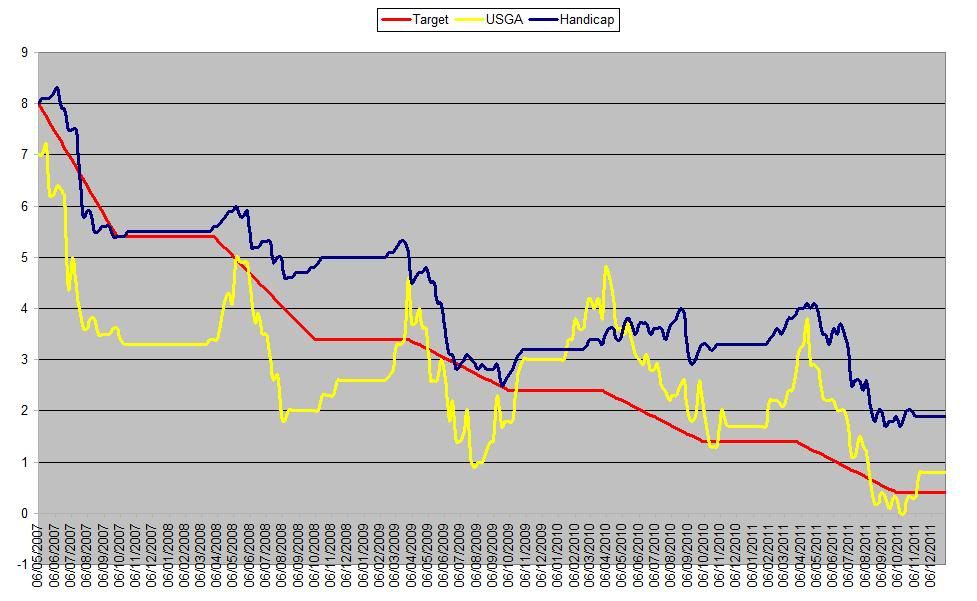
The graph to the left shows my UK Handicap (blue) v my US handicap (yellow) v my Target (red), since I started playing golf seriously again in 2007.

To start with, it’s no coincidence that the last 2 weeks are the only time that my US handicap has been higher than my UK handicap. This is because I had a really good summer in 2009, and I am now losing those good scores, and am replacing them with higher scores as I am playing during the winter for the first time. This links in with their being no allowance in the US system for playing conditions, it is incredibly difficult to play to the Course Rating in a UK winter.

You may also notice that in general, my US handicap is lower than my UK handicap, this may be as I play mainly in more favourable than average conditions, although I do believe that for lower handicappers, because only the best 10 of 20 scores are being counted, it is a lot easier to reduce a handicap. In the UK system you need to be shooting sub-par rounds to be reducing your handicap by any tangible difference.

You may also notice that there is much more variance in the US handicap, the ups and downs are much sharper. I don’t think this is a bad thing at all, if anything it shows how difficult it is to adjust a UK handicap realistically when a player’s ability changes.

Last summer, under the US system, my handicap would actually have got as low as 0.9, under the UK system it didn’t get any lower than 2.5.

From now on, any handicaps that I post will contain my UK and US handicap, so that any stateside readers can compare my progress. The goal of this project, and associated blog, remains to become a scratch golfer under the UK system. When that happens, I know that I will have earned it.