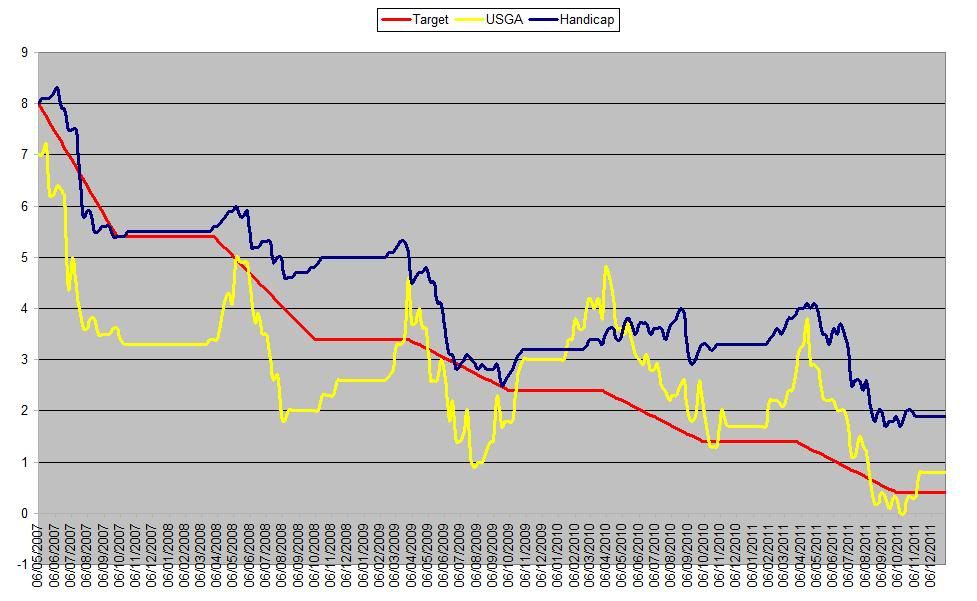
UK Handicap; 3.3 USGA Handicap; 1.7
Apologies for the lack of updates, but there has not been much to update on. Winter is officially here.
The day of my last post I played my last competition round of 2010. It was meant to be the penultimate competition of the year, but it is so cold, and the course is playing so long with greens that have the roll of a test site for the moon landings, that I decided that there is absolutely no point in playing again to try and get my handicap reduced, as it’s almost certain it would result in a 0.1 increase instead.
Despite the conditions, I actually played fairly well. Two birdies and two bogeys in the first 5 holes wasn’t too consistent, but I then rattled off 8 pars, followed by 2 stupid bogeys, followed by another 3 pars. So I walked off with 37 points, one better than my handicap, and what I considered to be a very good score.
The UK system of handicapping is good in that the Competition Scratch Score can alter based on the conditions of the day, so there was the possibility that I would get more than 0.1 reduced from my handicap due to the harsh playing environment. The downside is that the CSS uses the scores of the competition to decide what alteration, if any, there should be. So it’s open to statistical anomalies, especially where there are a small number of competitors, and a few of them score 34 points or better. In fact, in an event where all the entries are category 1 players, and everyone scores 35 points, the CSS would actually move downwards and everyone’s handicap gets increased, even though the worst score was 35 points. The calculation also doesn’t take into account a few people all having a good day on the same day.
Note that when the competition is stableford (i.e. the scores are around 36 and the higher the points the better the score), the CSS ‘coming down’ actually means you need more points to play to your handicap. Where the competition is strokeplay (i.e. the scores are around 70 and the lower the score the better) the CSS coming down means just that, to play to my handicap I need to shoot one shot less than normal.
That is unfortunately what happened in this competition, as 5 of the 11 entrants (45%) scored 34 points or better, and the chart for this makeup of competition states that the CSS comes down if more than 44% of entrants score 34 points or better. So instead of needing 36 points to play to my handicap, and get cut 0.1 for every point I get above 36, I actually needed 37 points to play to my handicap, and 38 or more to get cut.
The end result is that I finish the season on 3.3, not a disaster but not the progress I had hoped for either. I played my best golf of the year in the final 2 months, I have a few months to figure out what the difference was in that time and make sure I can keep it into next year.
Over the winter I am aiming to play once a week, and the Tigers section of my club have agreed to have a meeting once every 3 weeks, plus a matchplay event over the winter months. This will keep everyone’s eye in, instead of the temptation to put the clubs away for the winter and dust them off in March.
The first of the 3-weekly events was on Saturday, and as if an omen, it snowed on Friday night. There were seven brave (or foolish, I can’t decide which) people who turned up on Saturday, and we played 9 holes in about ½ inch of snow. It was a bit of a lottery, but good fun overall. 5 of the 7 managed to get 14 points or more over 9 holes, which was actually not bad, and we managed a couple of birdies, and an eagle on a 400 yard par 4, between us.
Next up for me is a lesson in a couple of weeks time, in order to get some things to work on over the winter, other than that it will be the occasional round just to keep things ticking over, I’ll endeavour to keep this blog up to date with any interesting developments, either involving my game or other topics I happen to come across.
Monday, 29 November 2010


Friday, 12 November 2010
A Supplementary Bonus
First of all, happy 100th blog post to me! It’s taken less than a year, and although I’m well behind my target golf-wise, I’m pleased with my persistence with this blog, as many other blogs on a similar subject have come and gone without a trace. Here’s to the next 100 posts.
I have started planning for next year already, which has thrown up some interesting logistics, and an unexpected bonus.
As has been previously detailed, after my last qualifying competition for 2010 which takes place tomorrow, I will have played in 56 qualifying competitions. This is quite a good number, but I need to really ramp that up next year, together with a lot of hard work, if I want to progress. There are several ways I am going to make this happen.
Firstly, I am going to join a golf club in Scotland
In addition to this, I have already gone to extreme lengths to maximize the number of qualifying competitions I can play in. There is one particular weekend where I have a 36 hole competition in Scotland Birmingham , then train to London
Secondly, the golf diary at my home club is a lot better for 2011 than it was in 2010. When I first joined this club I was baffled by the lack of qualifying competitions, 23 between April and September, next year there are 39, and are much better spread throughout the calendar. With these club competitions, and week long tournaments, I have already submitted my annual leave from work for 2011. Before the year has already started, I only have 2.5 days left from an entitlement of 28 days. So I’d better hope I don’t need any more time off work in the next year, as I’m not going to have the availability to take it. I also did a check of Friday afternoons, and from mid-April to end of September, I am going to work on 9 of them, and be off for the other 14. So if any work colleagues need me, don’t need me on a Friday afternoon!
Thirdly, I heard today that CONGU, the UK
So that means that every player, including me, can now submit up to an extra 10 qualifying scores per year.
The end results of these 3 changes are that my diary now shows that I currently have 83 opportunities to play for my handicap in 2011. Even I have to admit that is quite a large number. It’s worth remembering that I played in 56 this year and didn’t reduce my handicap, so the number of competitions and handicap reduction are not directly correlated, but if the goal of my journey is to get down to scratch, then the vehicle that can help me get there is the number of qualifying competitions. And I’d rather be travelling in the Porsche of 83 competitions, than the Astra of 56.
Sunday, 7 November 2010
Three Is A Guarantee
As we get to the end of the season, everything seems to get a little bit more difficult. There’s only 9 hours daylight per day at the moment, limiting the amount of golf that can be played. The ground is a lot wetter, meaning the ball doesn’t roll so far. The temperature has reduced dramatically also, meaning that an 8 iron that would have travelled 150 yards just 6 weeks ago is now travelling about 135 yards instead.
The penultimate competition of the year yesterday resulted in a score of 36 stableford points – exactly on my handicap. Normally I would consider 36 points as a waste of 4 hours of my life, but yesterday it seemed like an achievement. There are 3 reasons for this. Firstly, as detailed above, with the more difficult conditions it is much more difficult to play to my handicap when the ball is travelling much less distance. Secondly, I actually recovered quite well. I was 3 over par after 6 holes and then played the last 12 in level par. Thirdly, keeping my handicap static and not increasing 0.1 yesterday means I will definitely be playing off 3 at the end of the year – not exactly my dream last April but certainly better than having to call myself a 4 handicapper for the next few months.
After the satisfaction of yesterday’s round, I played again this morning, unusually for me in a social game. It’s wasn’t a competition, nor a club match, just a game of golf for the sake of playing golf. Having played the first 9 half decent, I played very poorly in the back nine, and tailed off to a disappointing 79. Having said that, in the last couple of months my good rounds have been in the non-qualifying games and my poor rounds have been in the competition rounds, so I should be grateful that I scored 74 79 this weekend and not 79 74.
My US Handicap took a bit of a jump this weekend, as 20 rounds ago I had a couple of very good scores, and they are being taken out of the equation and replaced with my current rounds. Although this week it has taken a jump from 1.3 to 2.0, over the next 10 rounds it can’t go any higher than 2.9, no matter what I score. The problem comes after those next 10 rounds, as of my current 10 counting rounds, 9 of them are consecutive. When these scores stop being included in the equation my handicap has the potential to jump up dramatically, hopefully I can put in the occasional decent round over the winter to keep things respectable.
Sunday, 31 October 2010
Dark Matter – Night Golf, Putting & Holes in One
I played Night Golf for the first time ever on Friday night. As you can imagine, Night Golf is exactly as it sounds. The tees, greens, bunkers and flagstick are lit by luminous markers, and the golf balls glow in the dark. Other than that it is completely pitch black. We played an event over 8 holes, all fairly straightforward par 4s, and I really enjoyed it.
It was a bit nerve-wracking standing over the first tee shot, having to trust your swing, but I hit a good one down the middle and soon got to grips with it. The balls only go about 70% of the distance of normal golf balls, so the clubbing needs adjusted accordingly. It is the sort of game that isn’t very enjoyable if you don’t hit the ball well, but fortunately for me I actually played quite well, and would definitely play again. It was also a great confidence boost knowing that I can trust my swing, and my ability to hit a ball is driven by a natural swing, rather than a visual adjustment.
On Saturday morning I played in a stableford competition, and once again managed to throw away a good round into the most frustrating result possible – missing buffer zone by one shot.
The main problem was putting; I missed 4 putts of 3 foot or less. When I only get 3 shots to play with in the course of a round, then losing 4 shots so easily is not going to lead to a happy ending. This may have been caused by me, but I’m fairly certain that the condition of the greens was also a factor.
There have been ongoing problems with the greens at my course for years, and a recent agronomist report was quite scathing. The short term impact is that tons of sand have been put on the greens, making short putts quite difficult as some of them break quite a lot and some others stay straight. I have 2 more competitions in 2010, so in theory I could be back up to 4 at the turn of the year, but I’m playing well enough to avoid this, and if I can sort the putting out then I don’t see why I can’t get cut.
I have never named anyone on this blog, but this next bit merits an exception. The round on Saturday was also notable for being the first time I have played with someone who got a hole in one. Having narrowly missed a hole in one by about a foot on the 13th hole (our 4th, as we teed off on the 10th), two holes later Steve Pope hit a beautifully crafted shot that landed on the green, disappeared over a slight slope in the green, and wasn’t seen again until we reached the green, couldn’t see his ball, and peered into the hole. Well done Steve, I enjoyed sharing your celebratory drinks too!
Thursday, 28 October 2010
The Cost Of Golf
Regular readers of this blog will know that I have done quite a lot this year; various trips up to Scotland
I have been tracking my competition profit and loss, to the penny, all the way throughout the year, so I’ll start with that first.
For the purposes of this exercise, when I enter a competition not all of the fee will be used in prize money, so I split it out between how much of my entry fee goes into the prize fund, and how much is used for other purposes, like green fees, trophies, or any other expenses that the competition organisers incur. For example, the Craw’s Nest Tassie had 345 people playing £185 each, giving an income of £63,825. But only £4,320 is paid out in prize money. So of my £185, only £12.52 (4320 / 63825 x 185) gets attributed to prize money, with the remaining £172.48 going towards green fees.
My fees that went towards prize money this year were £195.61, and I won £458.10 back in prize money, a very healthy return of 134% profit! I split out the ‘Magic 2s’ entry separately (‘Magic 2s’ are where competitors pay an entry, and a dividend is paid out for any 2 that is scored during the competition), and they show an entry of £37.00, and a return of £140.95, this time a profit of 281%!
So overall, my competitive profit and loss was +£366.44, or 157% profit. It’s worth reinforcing that I don’t play golf to win money, anything I do win is a nice bonus but it is not expected and is not the reason I spend hundreds of hours practising each year.
The reason the competition profit is not the be all and end all is because it barely makes a dent in my overall spending on golf over the course of the year.
The full cost of my golf for 2010 comes out at £3,261.60, and is split out into the following categories in the table below;

Based on the number of hours I’ve spent playing golf this year, I calculate that golf costs me £6.85 per hour. A completely uninteresting fact, but a fact all the same.
I put together a short comparison with other hobbies, and how much I estimate they cost per hour;
- Watching Chelsea; £31.00 per hour
- Watching non-league football; £6.00 per hour
- Going to the cinema; £5.05 per hour
- Going to the pub; £5.00 per hour
- Hillwalking; £3.00 per hour
- Going to the gym; £2.60 per hour
- Watching tv; £0.34 per hour
Although golf is more expensive that most of the other hobbies on that list, for me it represents that best value for money by far, due to the combination of the health and social benefits, and the availability of it. Going to the gym is the only other one that I think represents value for money, but is restricted by the number of hours that can physically be completed in a given time period.
I have put together a template budget for next year, which shows a very similar bottom line as 2010, but with the component parts being made up differently;

2010 was an extremely expensive year for new equipment, 11 of the 13 clubs in my bag, as well as the bag itself, were bought this year, and that will not be repeated in 2011. I also won’t be spending so much on green fees as I won’t be going away to play other courses, other than the courses already accounted for in the competitions line.
The saving of over £900 on equipment and green fees is offset by several cost increases for next year. The main three items that take up this cost are; increased membership fees; as I’m going to join a course in Scotland
So 2011 will cost another £3,200, but it will be worth every penny, and if I get down to scratch then it will be priceless.
Sunday, 24 October 2010
How Often Do I Play To My Handicap?
I’ve played 53 rounds of golf that have been for handicap adjustment this season, and my handicap is exactly the same now as it was when I teed off in the first of those rounds.
I was interested to find out the story behind that, and whether there were any clear trends including; how many times I went up, down, or stayed the same (in the ‘Buffer Zone’); whether playing on my home course was an advantage; whether I am an average player in terms of the distribution of these rounds; and what I can learn going into next year.
I looked at these 53 rounds, and where I finished in relation to the CSS for the day. The CSS is the Competition Scratch Score, and is effectively an adjusted SSS (Standard Scratch Score, US equivalent would be a course rating), taking into account the conditions of the day. If I play well I will be under the CSS and my handicap will be cut, if I play poorly I will be over the CSS, and if I am more than 1 shot above the CSS my handicap will increase. My Buffer Zone is being either exactly on the CSS, or 1 shot over.
The basic breakdown of rounds is shown in the table below;


I was interested to find out the story behind that, and whether there were any clear trends including; how many times I went up, down, or stayed the same (in the ‘Buffer Zone’); whether playing on my home course was an advantage; whether I am an average player in terms of the distribution of these rounds; and what I can learn going into next year.
I looked at these 53 rounds, and where I finished in relation to the CSS for the day. The CSS is the Competition Scratch Score, and is effectively an adjusted SSS (Standard Scratch Score, US equivalent would be a course rating), taking into account the conditions of the day. If I play well I will be under the CSS and my handicap will be cut, if I play poorly I will be over the CSS, and if I am more than 1 shot above the CSS my handicap will increase. My Buffer Zone is being either exactly on the CSS, or 1 shot over.
The basic breakdown of rounds is shown in the table below;

This shows that my handicap went up in just over half the competition rounds I played in, with roughly a quarter resulting in a handicap cut, and a quarter with Buffer Zone. Playing away from my home course showed that I was less likely to get cut, but I wasn’t any more likely to go up either; the rounds that on my home course would have resulted in a cut ended up in Buffer Zone instead.
Looking at a scoring breakdown of the 53 rounds turns up the following graph, with handicap increases in red, Buffer Zone in yellow, and handicap cuts in green.

This graph has an average of CSS +2.2, a median of CSS +2, and a mode of CSS +1.
So how does this compare with the average golfer? Well firstly, it’s difficult to compare generically as the breakdown for a high handicap golfer will look very different to that of a Category 1 (handicap 5 or less) golfer. The CONGU system in the UK
I have extrapolated the data to make it the same sample size (53) as my results for this year, and have plotted it on the graph below;

What this shows is that I am more partial to the odd disaster round (CSS +6 or more) than the average Category 1 player, however I am less likely to narrowly miss Buffer Zone (CSS +2 – CSS +5). I am more likely to make Buffer Zone or get marginally cut (CSS -2 – CSS +1), and the big reductions in handicap (CSS -3 or less) are similar to the sample size, although more sporadic in the distribution due to the very nature of them. Taking out the extremes of the table, I am about 1 shot ahead of the score distribution of the average category 1 player.
Simplifying the graph into percentages of cuts, Buffer Zones and increases, backs up this theory.

Forecasting this performance into next year, based on my current diary of 71 competition rounds, would result in 16 cuts, 19 Buffer Zone, and 36 increases. Having modelled performance using a variety of different methods, in order to get to scratch next year, I need to turn 8 of the increases into Buffer Zones, and 8 Buffer Zones into cuts (or alternatively 8 increases directly into 8 cuts, which is effectively the same end result, but it’s a lot more realistic to make a slight improvement in 16 rounds as opposed to a large improvement in 8 rounds). That would result in 24 cuts, 19 Buffer Zones, and 28 increases. Getting my handicap cut 24 times out of 71 rounds is a very tough ask, but at least I can now see the scale of what requires to be done.
In terms of pure scoring, in order to achieve this I need to shave 2 shots of every score next year. That doesn’t sound much, most times I come off of a golf course I can identify at least 2 silly missed putts, or poor chips, or drives into trouble, that have cost me a shot. The difficult bit is eliminating them. The most important rounds to do this in are the ones that are CSS +3 or less. There will always be off days, and the ones that result in finishing more than 3 shots over the CSS should just be written off, thrown in the bin, and forgotten about. The difference between CSS +2 and CSS +1 is 0.1 on my handicap, likewise for every shot below the CSS is another 0.1 closer to scratch. Shaving 2 shots off of a disaster won’t make any difference, but turning a narrow failure into Buffer Zone, or a good round into a very good round, will be where the difference is made next year.
Wednesday, 20 October 2010
2010 Review of My Majors
At the start of the season, I set out my targets for the seven major competitions I was scheduled to play in. The diary changed a couple of times, and I ended up playing in 9 competitions that I would call major.
Each competition had it’s own target, but I said at the start of the season that “the overall target for 2010 is to achieve 2 or more (of the individual targets), or 1 or more if the 1 is the Club Championship”.
So how did I do then?
Worman Sword; Target – Top 12, Actual – No Return
This was a complete disaster, from a cash machine swallowing my bank card and refusing to give it back on my way to the course, to being hit by an errant drive in my first round, to the freezing cold despite being in May, and ultimately not returning a score in my 2nd round
Forfar 36 Hole Open; Target – Top 6, Actual – Cancelled due to flooding and replaced with…
Strathmore 18 Hole Open; Target – Top 6, Actual – Tied 2nd
I played really well in this, hitting 14 greens in regulation. I didn’t win anything on countback, but tied 2nd was better than I could have hoped for when I turned up at the course.
Mediocrity was order of the day here. Two rounds of 5 over par saw me comfortably miss the cut, but improve on the prior year performance.
Club Championship; Target – 1st, Actual – 2nd
Another one where I improved on last year, but still fell short of the goal. Having said that, I couldn’t have got much closer, being tied after 36 holes and then after another 4 play-off holes, only to lose at the 5th sudden death hole. The four years I have played in this I have finished 12th, 7th, 3rd and 2nd, so if I can maintain the year on year improvement then there is only one place to finish next year.
Aboyne Open; Target – Top 8, Actual – No Return
After 11 holes I was looking at easily hitting target here, only to come across an insanely difficult last 7 holes. The rough was unlike anything I’ve seen in years, I couldn’t keep the ball straight enough off the tee to avoid it all
Royal Montrose Open; Target – Top 10, Actual – 12th
Close but no cigar here, but it felt like an achievement finishing 12th. The wind was gale force, and the time I played got the worst of it, standing up straight was a challenge in itself.
Montrose Golf Week; Target – Last 16, Actual – Last 16
Qualifying was a bit of a struggle, I had a pull a few escapes out of the bag in the closing holes, but my last 32 match went as well as I could have hoped. I just didn’t perform in the last 16 match, but ultimately it was a successful week
Monifieth Open; Target – Top 6, Actual – 12th
Poor start, moderate middle, good finish. Not quite close enough to trouble to engraver, but it was an acceptable performance
Craw’s Nest tassie; Target – Last 64, Actual – 81st
Ultimately this will go down as a failure, but like the Royal Montrose Open, I didn’t get the best deal in regards to the weather and the draw. I have never played in conditions like those that I encountered in the second qualifying round, and the week had a great finish when I knocked it round Carnoustie Championship in 74 shots off the back tees, getting my handicap cut and picking up some cash too.
So, in categorising the 9 competitions, they come out as follows;
2 x Achieved
2 x Nearly Achieved
2 x Improved on Prior Year but Not Achieved
3 x Not Achieved
My goal was to achieve 2, and I achieved 2, so going by the literal interpretation of my targets 2010 was a success. The fact that I didn’t achieve target in any of the three most important (Club Championship, County Championship, and Craw’s Nest Tassie) takes the shine off it, and also my handicap being exactly as it was at the start of the season is a bit of a downer, but a positive way of looking at it is that I have a lot next season that I can improve on.
Subscribe to:
Posts (Atom)


 Posts
Posts


